


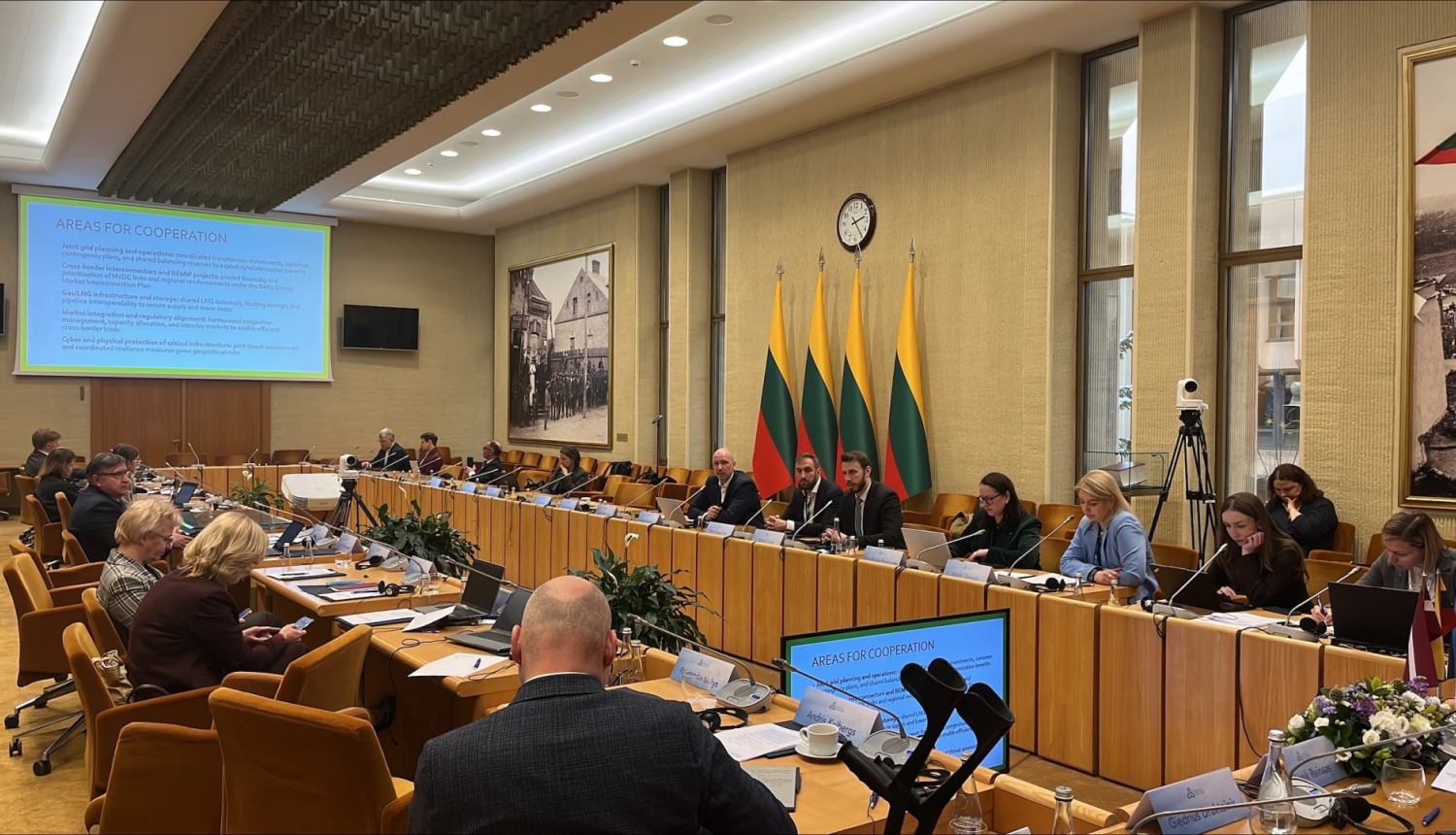
On 6 February, the Baltic Assembly convened in Vilnius to address strengthening regional cooperation with a focus on the progress and future delivery of Rail Baltica. During the session, members received an update on the project’s implementation status, financial outlook, and strategic importance and the challenges facing large-scale infrastructure projects.
Addressing the Assembly, RB Rail AS Chief Executive Officer Marko Kivila highlighted the project’s transition from planning to full-scale construction across all three Baltic states.
“Rail Baltica has moved decisively into the construction phase, with progress in Estonia, Latvia, and Lithuania. More than 267 kilometres of the mainline are now construction-ready – over 40% of the mainline - and major sections are under active construction. This demonstrates the strong commitment of the Baltic states to deliver this strategic corridor,” said Marko Kivila.
Discussions at the Assembly also focused on the importance of predictable and stable financing. Participants noted that the timely completion of Phase I by 2030 remains closely linked to the availability of sufficient EU support under the next Multiannual Financial Framework.
Kivila emphasized that the current timeline was developed based on specific assumptions regarding funding continuity and construction capacity. “The schedule was prepared on the basis of full financing availability and uninterrupted access to construction resources. It leaves limited flexibility for unforeseen challenges. Under these conditions, achieving the 2030 target across all three countries will require sustained and coordinated efforts to ascertain these original assumptions,” he said.
“If the conditions underpinning the current schedule change, particularly with regard to the availability of financing for construction works, the timeline will inevitably be affected. This applies both in cases where EU funding does not meet initial assumptions and where national financing is delayed or alternative financing instruments require additional time to establish. If assumptions change, the schedule changes,” Kivila explained. “The project has developed several implementation scenarios based on different financing conditions. However, as key funding decisions are still pending, the 2030 timeline remains our main reference point and operational target.”
He noted that operational sections are expected to be ready by 2030, although completion of the full network will depend on securing sufficient financing. Estonia is progressing toward establishing a connection between Tallinn and Pärnu by 2030, while in Lithuania the Kaunas–Panevėžys section is expected to become operational, with further connectivity to the Polish border possible through existing infrastructure. Kivila added that implementation conditions vary between countries and that some sections involve more complex delivery environments.
“In Latvia, the legal environment for design, as well as a different mainline contracting setup, has resulted in a different implementation sequence and risk profile compared to Estonia and Lithuania,” he explained. “While mainline construction has already started, achieving full operational readiness depends on securing financing and managing costs effectively. These factors directly influence the overall timeline and remain essential preconditions for maintaining progress in line with current projections.”
He further stressed that long-term certainty under the Connecting Europe Facility is essential to safeguard delivery and avoid further delays.
The Assembly underlined Rail Baltica’s role as a core component of the Trans-European Transport Network, contributing to economic growth, regional integration, climate objectives, and military mobility on the EU’s eastern flank.
About Rail Baltica
Rail Baltica is one of the largest high-speed rail projects in Europe and is part of the Trans-European Transport Network. It aims to improve connectivity, strengthen regional security and support economic growth in the Baltic states. The new railway will link Estonia, Latvia and Lithuania with Poland and, indirectly, with Finland, as well as with the broader European rail network.
Rail Baltica will be fully electrified with a standard gauge of 1435 mm and it will be equipped with ERTMS (European Rail Traffic Management System). It has been designed to meet European standards. With a design speed of 249 km/h, Rail Baltica will reduce travel times between the Baltic states and major European cities by more than half. It will serve as a modern infrastructure for passenger, freight and military mobility, promoting accessibility and facilitating business, tourism and cultural exchange. Rail Baltica will help establish the Baltics as a key link in European trade and cooperation.
For further information:
Signe Nīgale
Head of Communication and International Relations Department
RB Rail AS